


How to become a Skipper

What does a Skipper do?
A Skipper is in charge of the safety and operational management of a vessel, the crew, passengers and cargo. Regardless of the type or size of vessel, the fundamental responsibilities are the same.
- Vessel navigation: A Skipper plans the routes and voyages, reads nautical charts and GPS systems, monitors weather and sea conditions, and manages navigational risks. Navigation is more than just steering the vessel but a continuous, decision making process combining technology, observation and experience. One of the most critical skills of the role is to safely plan and control the vessels movements and comply with navigational standards and operational requirements as set out by the Australian Maritime Safety Authority.
- Safety management: Skippers are legally responsible for the safety of everyone onboard including passengers and crew. They are also responsible for the safety of the vessel itself. As part of the safety management responsibility, Skippers must train crew, plan for risks, maintain equipment, ensure emergency procedures, and follow legal safety standards.
- Crew leadership: Strong leadership is an essential responsibility of a Skipper. It ensures that crews work safely and efficiently particularly in challenging situations. The boat captain must direct the crew's actions by assigning duties, monitoring performance, managing teamwork and maintaining safety standards.
- Vessel maintenance: The Skipper is responsible for keeping the vessel safe and seaworthy prior to and during the voyage with routine inspections and overseeing repairs and maintenance.
- Passenger welfare and customer service: A Skipper, particularly in tourism, charter or ferry operations, has customer service responsibilities. They are responsible for passenger welfare and safety by ensuring safe boarding and disembarkation, welcoming passengers and handling complaints or difficult situations.
Skills and traits required to be a Skipper
Being a Skipper requires more than just being able to steer a boat. It requires a range of skills and personal traits to manage a crew, passengers and vessel safely. The key skills and personal qualities to be a successful Skipper are:
Technical skills:
- Navigation
- Marine radio operation
- Weather interpretation
- Vessel handling
- Maritime law
- Mechanical
Safety skills:
- Emergency response
- First Aid and CPR
- Survival procedures
- Risk assessment
Personal qualities:
- A respect for the water
- Calmness in emergency situations
- Physical stamina
- Responsibility and accountability
- Problem solving and adaptability
- Conflict management capabilities
- Situational awareness
- Customer service
- Communication skills
- Decision making confidence
Pathway to become a Skipper
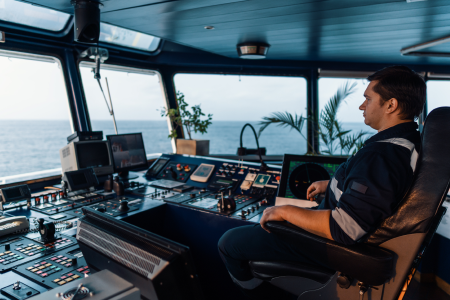
There are several pathways to becoming a Skipper, including training, certifications and practical sea experience. Maritime careers are built step by step, allowing you to gain skills and knowledge as you advance. Whether you decide to be a Skipper of a small boat, fishing or dive charter or commercial boat, the pathway requires advancement through levels of qualifications. Some people start as an entry level crew member or deckhand, gaining mandatory sea hours. Others may find getting a boat license triggers the ambition to become a Skipper. Commercial marine qualifications are regulated nationally by the Australian Maritime Safety Authority (AMSA) which ensures Skippers meet safety and competency standards across Australia. To become a Skipper and meet these requirements, this is a typical pathway.
- Complete marine safety and basic training: Before working commercially, it is an important step to complete essential training including first aid and basic safety. These include:
- The Certificate of Safety Training (COsT)
- First Aid: The “Provide First Aid” certificate is a first aid course to provide boat Skippers with the necessary qualifications for a commercial vessel.
- Marine Radio Training: All Skippers must have marine radio training.
- Work as a deckhand: Working as a deckhand is a good way to accumulate the necessary sea time and real life experience working on boats. To work as a deckhand, complete a General Purpose Hand (GPH) certificate. This is a lower level deckhand qualification that is often a certificate I and focuses on support roles on a boat.
- Complete an entry level coxswain course: A Certificate II in Maritime Operations (Grade 1 Near Coastal) is a step towards becoming a Skipper as it helps develop the skills to operate and maintain vessels up to 12 metres safely.
- Work and build sea time: Continue to build sea time by working on boats and gaining practical experience. Logged operational time is required to progress to Skipper status. It provides the opportunity to learn from experienced Skippers, practice navigation skills and develop situational awareness. The amount of sea time depends on the qualification. Entry level certificates generally require less experience, while Master qualifications require significant logged sea service.
- Progress to higher certificates: In the maritime industry, there are a range of certificates that provide different levels and skill sets. Progressing through to higher certificates is a common way to work up to becoming a Skipper.
Skipper licence levels in Australia
Australia has a licensing system for Skippers which starts at Coxswain levels through to Master certifications.
1. Coxswain Grade 3:
This is the lowest grade of coxswain, mainly required for small vessels under 12 metres in smooth waters or near coastal areas. It allows vessel operation within one nautical mile of the coastline and is limited to passenger capacity of six. This is usually a one-day course.
Responsibilities:
- Operate small commercial vessels
- Crew member work
Typical roles:
- Working on small tour boats or workboats
- Performing marine jobs at an entry level
Entry requirements:
- Minimum 16 years of age
2. Coxswain Grade 2:
This level offers more operational scope than Grade 3. It allows for operation in sheltered waters 5 nautical miles from the shore and at night. Grade 2 does not have the same strict, low passenger capacity as Grade 3 as it has no listed numerical limit. This course is usually four weeks part-time.
Responsibilities:
- Operate commercial vessels up to 12 metres
Carry passengers commercially
Typical roles:
- Fishing or dive charter skipper
- Small tourism vessel Skipper
- Water taxi operator
Entry requirements:
- Minimum 16 years of age
3. Coxswain Grade 1:
The Certificate II in Maritime Operations (Grade 1 Near Coastal) allows for operation of a vessel up to 12 metres in length with no specific passenger number dictated by the licence itself. It is a full-time course with a duration up to six months.
Responsibilities:
- The operation of commercial vessels measuring up to 12 metres
- Can have commercial passengers
- Organise and watchover crew
Typical roles:
- Fishing or dive charter skipper
- Tourism boat operator
Entry requirements:
- Minimum 16 years of age
- Swimming ability
4. Certificate III in Maritime Operations (Master up to 24 metres Near Coastal):
This certificate is for Skippers of vessels up to 24 meters, covering navigation, safety, and operations. It is one of the most common professional Skipper qualifications. It usually takes about four to five weeks full time to complete.
Responsibilities:
- Be the Skipper of vessels that measure up 24 metres
- Carry passengers commercially
- Supervise and monitor the crew
Typical roles:
- Master of commercial vessel
- Fishing or dive charter Skipper
- Small passenger ferry Skipper
- Whale watching vessel Skipper
Entry requirements:
- Minimum 16 to 18 years of age
- Holding of Coxswain Grade 1
- Required sea service on commercial vessels
- Current First Aid qualification
- Marine radio certification
5. Certificate IV in Maritime Operations (Master up to 45 metres Near Coastal):
This is the qualification for Skippers to command larger commercial vessels up to 45 metres, or mate on vessels up to 100 metres.
Responsibilities:
- Be in charge of commercial vessels up to 45 metres
- Passenger carrying on a commercial vessel
- Managing and supervising crew
- Conduct advanced commercial operations
Typical roles:
- Commercial vessel master
- Fishing or dive charter Skipper
- Passenger ferry Skipper
Entry requirements:
- Holding Certificate III in Maritime Operations (Master up to 24 metres Near Coastal) certificate
- Additional sea service in command or watchkeeping roles
- Advanced navigation and stability training
- Medical fitness certificate
- Safety and emergency training
6. Advanced Diploma of Maritime Operations (Master Unlimited):
This is a high level diploma which is required for those wanting to advance to become a ship Captain. It usually takes 12 months to two years to complete. This level is different from a boat Skipper as it allows command of ships of any size, international voyages and the command over large commercial shipping operations. A ship Captain typically commands cargo ships, cruise liners and tankers.
How much do Skippers get paid?
The salary of a Skipper typically ranges between $92,000 and $134,000 per year, depending on the licence level and industry. Approximate ranges for each level are:
- Coxswain Grade 2: $60,000 - $80,000
- Coxswain Grade 1: $70,000 - $95,000
- Master up to 24 Metres: $80,000 - $120,000
- Master up to 45 Metres: $100,000 - $150,000+
- Master Unlimited: $150,000 - $300,000+
Becoming a boat captain is a rewarding career with highly structured stages. Starting as an entry level coxswain, you can progress through to a master certification to improve your skills, knowledge and earning potential over time. South West TAFE offers courses for a maritime career so contact them today to find out more.