


How to choose a career safe from the negative impact of AI

With the capability of handling routine, data heavy and predictable tasks, clerical administrative and customer service jobs face the highest risk from AI with approximately 13 per cent of these roles expected to be automated by 2050. Choosing a career that is safe from the negative impacts of AI means focusing on roles that require a high level of creativity, complex human empathy, skilled manual labour and strategic decision making.
What is AI?
AI is the acronym for artificial intelligence. It refers to machine-based systems that simulate human intelligence to perform tasks like reasoning, content generation and learning. In basic terms, AI is a sophisticated computer program designed to think and reason like a human being. It works like the human brain works, by assembling all sorts of inputs and then working with that data to create results. The process of AI starts by collecting huge amounts of data and then looking at key information from the assembled data to recognise patterns.
How does AI negatively impact employment?
While the introduction of AI may create some new opportunities in the workforce, it also can have a negative impact on employment. By automating routine tasks, augmenting human capabilities and shifting required skills, there is the potential for widespread job displacement and automation. The negative impact of AI on employment can range from job displacement and reduced hiring to rising inequality and the degradation of job quality. A breakdown of the negative impacts are:
- Job displacement and reduced hiring: Nearly 30per cent of companies are reporting hiring fewer employees due to AI anticipation. While it hasn’t had this impact yet, there is reduced hiring across a range of industries. Banking, manufacturing and customer service are experiencing early impacts with predictions that 80 per cent of customer service roles will eventually be automated.
- Widening economic and gender inequality: As currently a higher proportion of women work in clerical and administrative roles, they are more exposed to AI-driven job displacement. Approximately 29 per cent of female-dominated occupations are exposed to AI, compared to 16 per cent of male dominated occupations.
- Degradation of job quality and wellbeing: Exposure to technology like trackers and robots can have a negative impact on an employee’s job quality. A survey of more than 6000 people found that the more workers were exposed to AI tools like wearable trackers or automated technologies, the worse their health and wellbeing became.
- Overreliance and quality control issues: Overreliance on automated tools has the potential to cause severe quality control issues. AI is based on limited or biased data which can result in inaccurate or discriminatory outputs if not monitored properly.
Top industries affected by AI
- Finance and banking: AI has caused a structural shift in banking and finance, transitioning from human workers doing bank telling, data entry and document processing to generative AI. Most banks have relatively few staff behind the counter in customer service roles. Call centres of human workers have been largely replaced by AI-powered chatbots for routine enquiries. AI also assesses customer data and credit scores to make instant decisions on lending, which reduces the need for manual loan assessment and underwriting staff. On a positive note, AI has also transformed the banking and finance sector so that transaction data can be analysed in real time to spot anomalies and identify scam patterns.
- Technology and software: Software development and technology is one of the most heavily impacted areas by AI. Artificial intelligence has changed software development and taken it to the next level by accelerating coding, automating testing and enhancing bug detection. People with training in using AI tools are more likely to be hired in the future.
- Marketing and media: As AI can generate copy, blogs and social media posts quickly, the marketing and media industry has been significantly affected. Writers, authors, content creators, copywriters and journalists are seeing a difference in job availability and requirements.
- Legal services: AI can perform legal research, contract analysis and document preparation which is having a large impact on the legal services sector.
- Retail and customer service: In the retail industry, nine out of 10 retailers are adopting AI solutions for handling stock checks, customer enquiries, and scheduling. Customer facing roles are also changing with chatbots often becoming the first point of contact.
- Transportation: Transportation faces significant disruption with the emergence of artificial intelligence. Changes include everything from autonomous trucks to predictive analytics in fleet management, and logistics automation. While the use of AI can increase efficiency, safety and logistical optimisation, it can also replace human roles such as long-haul truck drivers, dispatchers or clerical workers.
- Education and training: Although it is not expected that teachers are completely replaced by AI, educator support staff and post-secondary teachers are considered high exposure. AI has changed the way teachers work by automating administrative tasks such as marking and attendance. It also analyses student performance and tailors individualised lessons to suit.
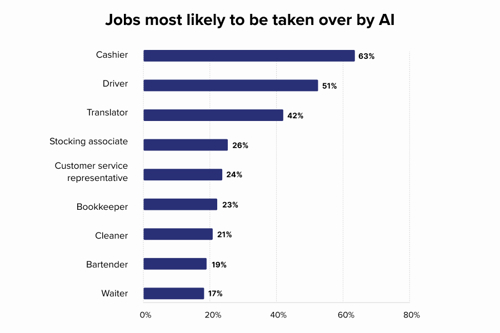
Least Vulnerable Roles
The jobs that are least vulnerable to artificial intelligence usually require manual dexterity, complex physical manipulation, high stakes human judgement or deep empathy. While AI is excellent at automation of routine tasks and data analysis, it is incapable of fully replicating human intelligence and physical ability. The roles most resistant to artificial intelligence are:
- Skilled trades: Skilled trades are considered safe from AI as they require complex, unpredictable and hands-on work in unstructured physical environments. Roles such as electricians, plumbers, construction labourers, carpenters and automotive mechanics are difficult to automate as they need in person problem solving skills, human interaction and adaptability. Electricians are largely safe from AI as they work in physical, highly variable circumstances that require real world troubleshooting that automated robots are not capable of. Plumbers have to deal with messy, varied and physically-demanding work that AI could not handle.
- High stakes health care: Careers in the health care industry require human empathy, ethical judgement and physical interaction which are largely human traits that AI cannot replicate. Surgeons, nurses, mental health professionals, emergency physicians, and GPs are fundamentally human-centric roles safe from AI.
- Education: Teachers and early childhood educators have certain tasks in their role that are prone to being converted to AI. However, these roles require primary carers to be directly responsible for children, monitoring and nurturing their social, emotional and educational environment which AI cannot do.
- Management and leadership: Executives and management roles are largely safe from AI as they are responsible for making high stakes ethical decisions and fostering organisational culture. AI serves as an advisory tool for automation and data analysis, while leaders and managers are involved with managing human dynamics, building trust and maintaining accountability.
- Emergency Services: Firefighters, paramedics, and first responders are safe from AI as their role involves split second judgement, empathy and physical adaptability in unpredictable environments. These roles operate in chaotic situations and have to make life or death decisions that are beyond the capabilities of artificial intelligence.

How to choose a career safe from negative impact of AI
To choose a career safe from the negative impact of AI, focus on careers that have a high level of human interaction, emotional intelligence, problem solving, and manual dexterity. To choose a career that is largely reliant on human characteristics and traits. This guide will help you choose a career safe from artificial intelligence.
Prioritise human centric fields
Understanding and choosing human centric fields is the first step to choose a career that is safe from AI. Artificial intelligence cannot replicate human qualities which means roles like teachers and healthcare workers are the least likely to become automated.

Focus on trade careers
As trades use hands-on skills they are less likely to be overtaken by artificial intelligence. According to the McKinsey 2024 report, less than 5 per cent of skilled trades can be automated. AI cannot physically work in dynamic roles such as electrical, plumbing, building, hairdressing and mechanics. These roles all require adaptability, problem solving and physical skills.
Choose courses that are less likely to be impacted by AI
To choose a course that is AI- proof, go to the TAFE website and look at areas and consider careers that machines cannot currently replicate. Focus on areas that are hands-on, people-focused and require real world experience and judgement. The best courses to choose for a career safe from the negative impact of AI are:
- Healthcare and Community Services: These are some of the safest careers long-term in this sector:
- Trades: Skilled tradespeople are amongst the most AI resistant careers. The top trades courses to pursue include:
- Certificate III in Carpentry (Apprenticeship)
- Certificate IV in Building and Construction
- Certificate III in Electrotechnology Electrician (Apprenticeship)
- Certificate III in Light Vehicle Mechanical Technology (Apprenticeship)
- Certificate III in Plumbing (Apprenticeship)
- Certificate III in Engineering - Mechanical Trade (Apprenticeship)
- Certificate III in Engineering - Fabrication Trade (Apprenticeship)
- Education and Childcare: As human interaction is the main part of this role, it is one of the most resistant to AI intervention. Courses to pursue in education and childcare are:
- Hair, Beauty and Massage: This is a hands-on and personal career that cannot be taken over from artificial intelligence. These courses are popular in the beauty sector:
To choose a career that is safe from the negative impact of AI, it is important to focus on roles that require human interaction, empathy and physical skills. While artificial intelligence can have some benefits for employment, the negative impact includes job displacement and gender inequality. South West TAFE has a large range of courses that are ideal for career pathways safe from AI.